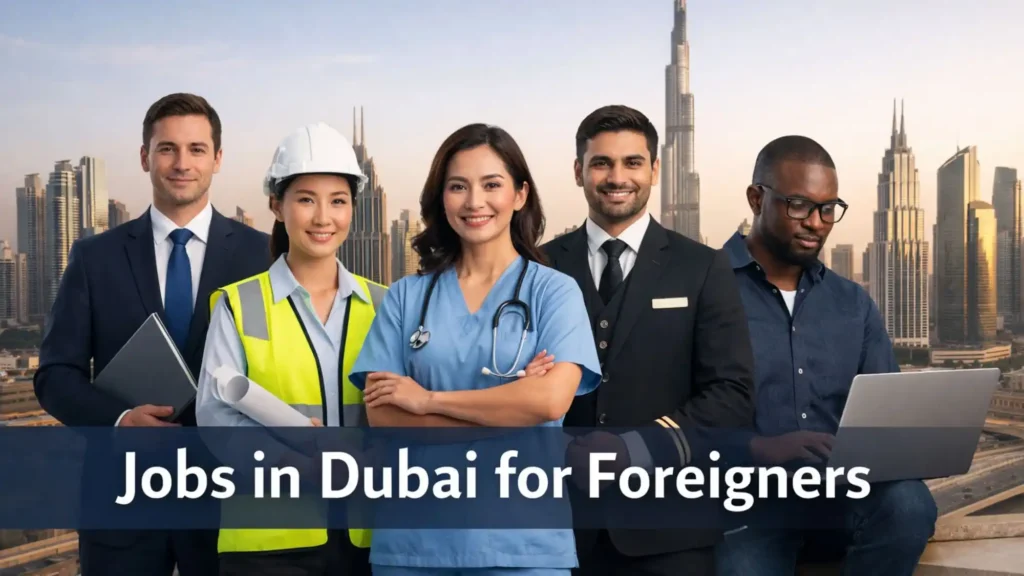
For many people planning a Gulf move, jobs in Dubai for foreigners are not just a search term. They are a real plan for better income, broader career options, and a chance to build long-term stability in one of the region’s most international cities. Dubai remains attractive because it combines business activity, strong employer demand across multiple sectors, and a professional environment that can reward both specialist and operational talent.
At the same time, the search can feel messy. You will see ads for jobs for foreigners in Dubai, recycled vacancy pages, vague recruiter messages, and salary claims with no context. That is why this guide is built as a practical hub post for people comparing job opportunities in Dubai for foreigners, trying to understand the Dubai job market, or deciding whether to target jobs in UAE for foreigners more broadly and then narrow the search to Dubai.
This guide is built for anyone planning that move, whichever term you searched to get here. It covers which sectors are actually hiring right now, realistic salary ranges by role, the paperwork behind legal employment, and how to apply without falling for the scams that specifically target this search.
Dubai is not a shortcut city. It is a systems city. If you understand where demand sits, what employers actually sponsor, what your skills are worth, and what the legal steps look like, your chances improve a lot. If you chase random offers without a plan, the search gets expensive and frustrating very quickly.
For more in-depth guidance on applications, visas, salaries, and career planning, explore our Dubai job guide.
Why Dubai continues to attract foreigners and expats
A big reason people want to work in Dubai is that the city sits at the center of regional and global business operations. Employers in trade and logistics, aviation, hospitality, real estate, healthcare, finance, retail, construction, and technology all use Dubai as a commercial base. For many candidates, working in Dubai for foreigners is attractive because the UAE does not levy personal income tax on salaries and other employment income, which keeps tax-free income and tax-free salaries at the center of the discussion for many job seekers. Dubai’s official economic positioning also continues to highlight sectors such as finance and wealth, technology and ICT, construction and real estate, retail and e-commerce, healthcare and pharmaceuticals, manufacturing, and energy and cleantech.
Another reason Dubai draws so much attention is its expatriate-based workforce. Multinational companies, regional groups, local family businesses, free zone companies, and Dubai-based companies regularly hire international workers and international professionals. English is widely spoken in many workplaces, which helps multilingual professionals and skilled international professionals enter the market faster, even though knowledge of Arabic can still improve your options in customer-facing, government-linked, or local-market roles.
Is Dubai still good for career growth if you are a foreigner?
Yes, but the answer depends on fit. Dubai can support career aspirations, career goals, and real career growth when your profile matches a sector with active hiring and when your work experience is clearly presented. People with advanced educational qualifications, strong professional skills, solid work experience, and specialized skills usually compete for better roles faster. But the city also has a large volume of low-skill jobs in logistics, supermarkets, hospitality support, transportation, security, domestic services, and warehouse operations.
The key is not simply asking whether Dubai is good. The better question is: good for which profile, at which salary level, and with which benefits package?
A realistic look at the Dubai job market in 2026

The current Dubai job market rewards relevance more than ambition. Employers do not just ask whether you want to move; they ask whether you solve a current business need. In practical terms, that means some job openings in Dubai move fast because they support expansion, customer service, digital transformation, or core operations, while others stay competitive because the applicant pool is huge.
The broad picture is favorable for foreigners because Dubai’s economy remains broad-based. Official Dubai investment material continues to spotlight technology and ICT, finance and wealth, healthcare and pharmaceuticals, construction and real estate, retail and e-commerce, manufacturing, energy and cleantech, food and agriculture, and trade and logistics. Dubai’s D33 agenda also continues to frame the city as a major place for living, investing, and working, which matters because a diverse economy creates multiple entry points instead of only one boom sector.
So when people search for Dubai job opportunities or work abroad in Dubai, they are really looking at several job markets at once:
- a professional market for finance, compliance, software engineering, data science, artificial intelligence, cybersecurity, engineering, education, and healthcare
- a service market for hospitality, tourism, guest services, hotel management, events management, luxury hotels, resorts, retail, and corporate services
- an operations market for logistics, transportation, supermarkets, warehouse support, security, delivery, construction support, and domestic services
Which sectors are strongest right now?
Technology remains important because businesses across sectors are modernizing systems, digitizing operations, and investing in automation, cloud tools, and analytics. That supports hiring in software engineering, data science, cybersecurity, digital transformation, and artificial intelligence, especially for roles like AI engineer, cybersecurity analyst, IT specialist, and project manager.
Finance continues to be strong because Dubai is home to banks, investment firms, fintech companies, wealth platforms, and back-office regional operations. That creates demand in finance, fintech, compliance, risk management, digital banking, investment banking, accounting, and audit-linked roles such as accountant and management accountant.
Healthcare also matters because Dubai continues to invest in healthcare delivery and medical tourism, creating space for nurse, physician, allied support staff, administrators, and specialists across private hospitals, clinics, and related life sciences functions. Official Dubai investment material continues to position healthcare and pharmaceuticals as a major growth area.
Construction, engineering, and real estate remain central to the city’s physical growth and commercial activity. This keeps demand alive for engineer profiles including civil engineer, mechanical engineer, electrical engineer, and environmental engineer, as well as project manager, technician, and site-linked support functions.
Hospitality, tourism, aviation, and retail remain some of the most visible pathways for expats because hotels, restaurants, malls, transport operators, and customer-facing employers hire at scale. That is why many first-time movers start by targeting receptionist, restaurant supervisor, sales associate, office assistant, store manager, guest services, kitchen assistant, and hotel-linked support roles.
Best jobs in Dubai for expats and foreigners by sector
If you are comparing the best jobs in Dubai for expats with the best jobs in Dubai for foreigners, avoid looking only at job titles. Look at title plus sector plus sponsorship likelihood plus total package. A role that looks smaller on paper can beat a higher title if it includes accommodation, transport, medical coverage, return flights, and a clear path to renewal.
Below is a practical sector-by-sector map.
Technology, AI, and digital roles
This area suits candidates with strong portfolios, certifications, and problem-solving ability. It is especially relevant for professionals with specialized skills and measurable project experience.
Common roles include:
- AI engineer
- cybersecurity analyst
- IT specialist
- software engineering roles
- data science roles
- implementation manager
- technical project manager
These positions often appear in multinational companies, high-growth firms, fintech startups, and enterprise service providers. For qualified foreign professionals, they are among the more well-paying jobs in Dubai for foreigners because they connect directly to business efficiency, security, and product delivery.
Finance, compliance, and corporate control roles
This track works well for candidates with formal qualifications, financial systems experience, and strong reporting discipline.
Common roles include:
- accountant
- management accountant
- compliance analyst
- risk management specialist
- treasury or digital banking support
- finance operations executive
- investment banking support roles
These jobs tend to reward structured experience and accuracy. They can also be strong options for foreign nationals who want stable employer sponsorship and long-term progression.
Healthcare and life sciences roles
Healthcare roles remain among the most reliable in-demand jobs in Dubai for foreigners, especially for licensed professionals and experienced support staff.
Common roles include:
- nurse
- physician
- healthcare administrator
- laboratory support
- medical coding and patient services
- medical tourism coordination
This area is stricter than many others because licensing, verification, and eligibility requirements matter. But once the licensing path is clear, the sector can be one of the strongest for long-term growth.
Construction, engineering, and built-environment roles
For technically trained candidates, Dubai still offers serious opportunities in construction and engineering.
Common roles include:
- civil engineer
- mechanical engineer
- electrical engineer
- environmental engineer
- project manager
- quantity-linked commercial support
- site technician
These jobs connect to infrastructure, buildings, facilities, industrial maintenance, and real estate projects. They can be especially attractive for professionals who already have Gulf or international project exposure, including candidates coming from oil and gas backgrounds and moving into broader engineering or project-delivery work.
Skilled trades sit alongside this category too. If plumbing is your specific trade, our plumber jobs in Dubai guide covers real pay ranges, certification requirements, and how to find genuine employers.
Hospitality, tourism, and service roles
This remains one of the biggest gateways into jobs in Dubai for expats and first-time entrants.
Common roles include:
- receptionist
- restaurant supervisor
- hotel management trainee or coordinator
- guest services associate
- events management support
- front office roles
- reservation and concierge support
Luxury hotels, resorts, food service groups, and tourism operators often hire people with strong communication skills, polished customer handling, and flexible schedules. English language proficiency matters a lot here, and knowledge of Arabic can help.
Logistics, transportation, retail, and volume-hiring roles
These are often the most visible options for people targeting job openings in Dubai quickly.
Common roles include:
- warehouse helper
- delivery driver
- supermarket staff
- sales associate
- cleaner
- security guard
- office assistant
- store manager
- stock coordinator
For many foreign workers, these are the first realistic entry points because labor demand is more constant and experience thresholds may be lower. But package quality varies widely, so the contract matters more than the title.
If a driving role specifically interests you, our driver jobs in Dubai guide breaks down real salary ranges by vehicle type, license requirements, and how to apply without getting scammed.
Education and training roles
Education is another meaningful channel, especially for qualified teachers and trainers.
Common roles include:
- Teacher
- English teacher
- Subject specialist
- Training coordinator
International schools, learning centers, language programs, and private operators can all hire here. Candidates with advanced educational qualifications and recognized teaching credentials usually stand out more.
Creative, marketing, and media-linked roles
Dubai also has room for commercially strong creative profiles, especially in branding, events, luxury, and social commerce.
Common roles include:
- photographer
- advertising executive
- art director
- campaign coordinator
- content production support
These roles are competitive, but the city’s mix of hospitality, retail, real estate, and lifestyle brands keeps demand alive for strong portfolios.
Quick comparison: where most foreigners should focus first
| Candidate profile | Best first targets | Why it works |
| Skilled tech professional | technology, fintech, software engineering, cybersecurity, data science | high business value, better salary expectations, easier long-term growth |
| Finance professional | finance, compliance, risk management, accounting, digital banking | stable demand and structured hiring |
| Licensed medical profile | healthcare, life sciences, medical tourism | strong sector demand once licensing is sorted |
| Engineer or site professional | construction, engineering, real estate, facilities | long-standing demand tied to projects |
| Service-oriented candidate | hospitality, tourism, guest services, retail | high vacancy volume and faster hiring cycles |
| Entry-level worker | logistics, supermarkets, security, warehouse, transportation | more accessible for low-skill jobs and support functions |
Which jobs are easiest to enter for foreigners?
The easiest routes are usually not the highest-paying routes. For many newcomers, volume-hiring sectors such as hospitality, retail, logistics, supermarkets, warehouse support, and security are easier to enter than tightly regulated or highly specialized roles. That does not make them better. It simply means the market has more openings and more employers willing to process sponsorship for operational roles.
Salary in Dubai: what job seekers should really understand
A lot of articles promise exact salary in Dubai numbers as if pay works like a price list. It does not. The real salary landscape in Dubai depends on the sector, employer type, your passport and language profile in some cases, years of work experience, certifications, shift patterns, housing arrangements, overtime, and whether benefits are provided separately or rolled into cash.
That is why jobs in Dubai with salary details can be useful as a search filter, but raw figures alone are not enough. Good salary transparency means understanding the full package, not just the headline amount.
What makes a salary package strong?
A good offer can include:
- base pay
- overtime rules
- benefits
- accommodation or accommodation allowance
- transport or transport allowance
- medical insurance
- annual leave
- end-of-service entitlements where applicable
For some workers, a lower monthly cash figure with accommodation and transport covered can outperform a higher cash offer where all living costs in Dubai are paid out of pocket. This is why salary information has to be read beside the cost of living in Dubai, not separately from it.
Are Dubai salaries really tax-free?
At the individual level, the UAE does not levy income tax on salaries and other employment income, which is one reason tax-free income and tax-free salaries remain a major draw for expats. But no personal income tax does not mean every job delivers higher income in practice. If your rent, commute, schooling, and food bill are high, the savings picture changes quickly.
Are well-paying jobs in Dubai for foreigners only for degree holders?
Not at all. Some well-paying jobs in Dubai for foreigners do require advanced educational qualifications, especially in healthcare, finance, engineering, education, and specialist technology roles. But certain commercial, sales, operations, and supervisory jobs can also pay well when the employer values experience, language ability, customer handling, or shift flexibility. Degrees help, but measurable skills, work experience, and sector fit often matter just as much.
Cost of living in Dubai and why your contract matters more than hype
The cost of living in Dubai can be manageable or stressful depending on your role, housing arrangement, transport costs, and family situation. Living costs in Dubai usually hit hardest in rent, transport, food, school fees, and lifestyle choices. So before accepting an offer, compare take-home cash with likely monthly expenses.
This is where many first-time job seekers make a mistake. They focus on the city’s image, booming economy, safe environment, impressive infrastructure, modern infrastructure, and the possibility of a high standard of living, but not on the contract math. Your real question should be:
- Is housing provided?
- Is there transport support?
- Are meals included in some jobs?
- Is overtime paid properly?
- Is medical coverage included?
- Are return flights and annual leave clearly stated?
- Is the employment contract aligned with the official job offer?
For service, logistics, and support roles, this contract math can matter more than title prestige.
Requirements to work in Dubai legally
The requirements to work in Dubai are more structured than many candidates expect. In the standard private-sector route, the employer starts with a formal hiring step. The basic legal flow is usually: official job offer, employment contract, work permit, entry permit, status completion, medical test, and Emirates ID-related steps, followed by residence visa issuance. Official UAE guidance describes the employment process around a formal job offer, work permit approval, residence procedures, medical testing, and identity-card processing for residents.
In other words, legal work is not supposed to begin just because someone sent you a PDF on WhatsApp.
The core documents and approvals most people should understand
Depending on role, status, and sponsor, you may encounter terms such as:
- work permit
- residence visa
- residence permit
- residency visa
- entry permit
- entry permit visa
- Emirates ID
- employment contract
- official job offer
- application form
- passport photos
- original passport
You may also hear older references to the Ministry of Labor. In current private-sector practice, the main authority is the Ministry of Human Resources and Emiratisation, or MoHRE. Official UAE and MoHRE resources also show that document requirements can vary by route and may involve employer-side items such as an establishment or company card, plus process-specific items like an application fee, a birth certificate in family-linked cases, proof of accommodations, a lease agreement, passport copies or photos, and other supporting documents depending on the category.
The important point is that document lists vary by category. Do not assume every applicant needs every document.
Can you work in Dubai on a tourist visa or visitor visa?
No. A tourist visa or visitor visa does not give you the legal right to work. People do travel to the UAE to explore the market, and there is also a jobseeker route for eligible applicants, but starting employment without the correct work authorization can lead to penalties. If an employer tells you to begin working first and “fix the papers later,” treat that as a major red flag.
Visa sponsorship jobs in Dubai: what that really means
Many candidates search directly for visa sponsorship jobs in Dubai or jobs in Dubai with visa sponsorship because they want employers who can handle the legal side of relocation. In the standard model, that is reasonable. The employer typically drives the visa sponsorship procedures for the work-linked route, beginning with the official offer and permit steps.
However, “visa sponsorship” is often used loosely in job ads. Some employers mean they sponsor the full work and residence process. Others mean only that they are open to candidates who already have valid status. Some agencies use the phrase as bait.
So when you see “visa sponsorship,” verify these points:
- Will the company issue an official job offer?
- Will the employment contract match the offer?
- Which work permit route applies?
- Who pays which official fees?
- What is the application process timeline?
- Are you entering on an entry permit for employment or some other status?
- When will the residence visa and Emirates ID steps happen?
If you want the complete walkthrough of fees, timelines, and every visa category available, our Dubai work visa guide for 2026 covers the process from application to residence approval in full detail.
The sponsorship side can still feel confusing because different employers and visa categories sit within a broader residency sponsorship system. In plain language, that means your right to stay and your right to work must line up correctly with the status issued for you or, in some cases, with a self-sponsored path that the law allows.
Some candidates also come from neighboring Gulf sectors such as oil and gas and then pivot into engineering, compliance, procurement, safety, or project delivery roles based in Dubai. And for international students already in the UAE, understanding the permit route is especially important before taking part-time or training-linked work.
Standard work visa, Green Visa, and other pathways
For regular employees in government and private-sector jobs, the standard work-linked route is the classic path. Official UAE guidance also states that the Green Visa is available for certain skilled employees on self-sponsorship. In addition, MoHRE lists multiple work permit categories, not just one, including routes for overseas recruitment, transfers, temporary work, dependents sponsored by family, and student training or employment in the appropriate circumstances.
That matters because not all jobs in Dubai for foreigners use the same legal route. A senior tech professional, a warehouse helper, an international student, and a dependent already living in the UAE may all enter the labor market through different permit mechanics.
The application process from job offer to legal residence
Here is the simplified application process most foreign professionals and foreign workers should understand. Official UAE guidance consistently places the sequence around the signed job offer, permit approval, residence processing, medical testing, and Emirates ID issuance.
Step 1: Get a real official job offer
The offer should come through proper channels and reflect real terms. Read title, salary, allowance structure, work location, notice terms, and any probation details carefully.
Step 2: Review the employment contract
Make sure the employment contract aligns with what you accepted. If the numbers or conditions shift dramatically, pause before moving forward.
Step 3: Employer applies for the work permit
In the private sector, the employer usually handles the work permit process through the relevant system.
Step 4: Entry and status steps
Depending on where you are and which route applies, this may involve an entry permit or entry permit visa followed by in-country status completion steps.
Step 5: Medical assessment and medical test
Residence processing generally requires a medical assessment and medical test. In practical conversation, many people also call the result a health certificate, even though the exact document language can vary by process. Official UAE guidance ties residence status to medical fitness checks for adults and related processing steps.
Step 6: Emirates ID and residence completion
Emirates ID is a mandatory identity document for residents. Once the residence side is completed, your legal employment setup is much more secure.
Step 7: Start work only after the legal route is in place
Do not rely on verbal assurances. The safest path is a documented one.
Special visa situations job seekers often misunderstand
Some people enter the UAE on a tourist visa, visitor visa, student visa, or even other categories such as visas for medical treatment and then assume any employer can simply “convert” them instantly. Real life is more structured than that.
- A tourist visa is for tourism, not work.
- A visitor visa may allow certain visit purposes, but it is not automatic work authorization.
- A student visa is for study status, and work depends on the relevant permit route and conditions.
- Visas for medical treatment are obviously not employment status.
- A jobseeker visit visa exists for eligible applicants who want to search legally without a host sponsor, but that still does not replace the need for the correct employment authorization once hired. Official UAE guidance says jobseeker visit visas are available for 60, 90, or 120 days, while visit or tourist status still does not permit working.
For this reason, always ask what legal status you will hold at each stage and which authority handles the change.
How to find jobs in Dubai without wasting months
If you want to find jobs in Dubai efficiently, stop using only one channel. Smart candidates combine:
- online job portals
- recruitment agencies
- company career pages
- social media for jobs
- networking with current employees
- direct outreach to Dubai-based companies
The most effective search method depends on your profile.
For corporate and specialist roles
Use online job portals, LinkedIn-style professional networking, targeted recruiter outreach, and direct applications to multinational companies, banks, consultancies, healthcare groups, schools, and major operators.
For hospitality, retail, logistics, and support roles
Use volume-hiring portals, walk-in announcements where legitimate, recruiter databases, hotel groups, supermarket chains, transport operators, and mall-linked employers. Keep your CV simple and role-specific.
For regulated or licensed roles
Go straight to employers and make sure you understand the certification or licensing sequence. Do not assume recruiters will solve everything for you.
Should foreigners use recruitment agencies in Dubai?
Recruitment agencies can help, especially for mid-level and specialist hiring, but they should not be treated as your only strategy. Use them as one channel, not the channel. Legitimate employers and legitimate recruiters should not ask you for improper payments just to secure an interview or a visa. If the message sounds rushed, secretive, or fee-based, walk away.
How to apply for jobs in Dubai the smart way
People often ask how to apply for jobs in Dubai as if the answer is one form and one website. In reality, the smartest method is to adjust by sector.
A practical application strategy
- Build one master CV and then create role-specific versions.
- Match your headline to the vacancy: accountant, HR officer, project manager, IT specialist, nurse, teacher, sales associate, receptionist, delivery driver, or warehouse helper.
- Add measurable work experience, not generic duties.
- Mention English language proficiency clearly. Add knowledge of Arabic if true.
- Keep location and notice period visible.
- Prepare digital copies of core documents, but do not share sensitive originals casually.
- Track every application in a sheet so follow-ups stay organized.
- Apply in batches by sector instead of randomly across unrelated jobs.
What employers actually notice
Employers usually care about:
- relevant work experience
- communication quality
- sector fit
- stability
- availability
- salary expectations
- whether you understand local laws and workplace expectations
For many roles, a modest but sharp CV works better than a glamorous one. Clear formatting beats decoration.
Jobs in Dubai with salary details: how to read listings without getting fooled
When you see jobs in Dubai with salary details, slow down and inspect the wording. Some listings show a monthly range but hide shift load, shared accommodation, transportation costs, or split allowances. Others advertise competitive salaries or competitive pay without explaining the real package.
Use this checklist:
- Is the salary range fixed or “up to”?
- Is accommodation included?
- Are return flights yearly or only after completion of contract?
- Is overtime paid?
- Is annual leave stated?
- Is medical insurance mentioned?
- Is the company named?
- Is the visa route clear?
The more vague the listing, the more questions you should ask before moving forward.
A practical role roundup: who should target what
Below is a simplified role map for search planning.
If you are early-career or entering fast
Target cleaner, warehouse helper, supermarket staff, kitchen assistant, security guard, delivery driver, receptionist, sales associate, office assistant, and entry retail or hospitality roles.
For a closer look at the easiest entry-level roles across the wider Gulf region, not just Dubai, see our guide to the top beginner jobs in Gulf countries.
If you are moving up from support to supervision
Target store manager, restaurant supervisor, HR officer, team coordinator, shift controller, transport coordinator, and operations support roles.
If you have formal professional training
Target accountant, management accountant, human resources manager, project manager, engineer, teacher, English teacher, nurse, physician, technician, and IT specialist roles.
If you are in specialist or future-facing fields
Target AI engineer, cybersecurity analyst, software engineering roles, data science roles, compliance, risk management, digital banking, and advanced engineering functions.
If you are in creative commercial work
Target photographer, advertising executive, art director, events management, luxury retail marketing, and brand support positions.
Local culture, language, and daily work realities
A lot of foreigners underestimate how much soft adaptation matters. Dubai is international, but it is still shaped by local laws, traditional culture, and local customs. Professional success comes faster when you respect that.
This does not mean you need to become a cultural expert before applying. It means you should understand workplace etiquette, communication hierarchy, punctuality, customer service expectations, and documentation discipline. In many offices and service settings, English is widely spoken, but courtesy, responsiveness, and respect for process matter just as much as language.
For customer-facing roles, hospitality, education, healthcare, and front-office jobs, English language proficiency is often essential. Knowledge of Arabic can improve customer trust and sometimes broaden role options, especially where the audience is regional.
Scams, fake sponsorship, and why verification matters
Scams are one of the biggest risks for people searching jobs in Dubai for foreigners from abroad. Fake agents often use phrases like guaranteed placement, urgent visa, instant joining, or huge salary with no interview. That is exactly why verification matters.
Official UAE guidance warns job seekers about labour and visa fraud, states that visit or tourist status does not authorize work, and stresses the need for a valid offer and formal process. MoHRE-linked guidance also warns people to avoid fake job offers and fake visa arrangements.
Red flags include:
- pressure to pay an upfront application fee directly to an individual
- no clear official job offer
- refusal to show company identity
- request to travel on tourist visa and start work immediately
- inconsistent salary terms
- refusal to share the employment contract before travel
- claims that documents can be skipped or “managed later”
One especially common trap is the so-called “free visa” job offer, a phrase that covers both legitimate employer sponsorship and a much riskier informal visa-selling arrangement. Our breakdown of what “free visa” offers actually mean explains how to tell the two apart before you commit to anything.
The safest approach is simple:
- verify the employer
- verify the recruiter
- verify the job title
- verify the sponsorship route
- verify the legal paperwork sequence
GulfDuty’s own published purpose matters here too. The site states that it is an independent informational platform, not a recruitment agency, employer, or visa service provider; that it charges no fees; offers no guarantees; and expects users to verify details independently before making decisions.
A realistic 30-day action plan to search for jobs in Dubai
If you are serious about search for jobs in Dubai, use a focused 30-day sprint.
Days 1 to 5: Position yourself
- choose two main sectors only
- rebuild your CV for those sectors
- prepare a short cover note
- organize passport, qualifications, and role proofs
Days 6 to 12: Build a target list
- shortlist 50 to 100 relevant employers
- identify online job portals and company pages
- map recruitment agencies that specialize in your sector
- follow relevant social media for jobs updates
Days 13 to 20: Apply in waves
- send tailored applications daily
- follow up where appropriate
- keep one tracker for title, company, salary note, and date
Days 21 to 30: Interview and verify
- prepare interview answers
- compare package details
- check sponsorship language carefully
- reject vague or fee-based deals
- focus on employers offering a clean application process
This method works better than panic-applying to hundreds of random jobs.
Final verdict: are there real job opportunities in Dubai for foreigners?
Yes. There are real job opportunities in Dubai for foreigners, and there are enough pathways for both high-skilled and operational candidates to justify serious attention. But the market rewards clarity. The people who do best are not always the most qualified on paper. They are often the most prepared.
If your goal is working in Dubai for foreigners in a legal, sustainable, and financially sensible way, remember the full picture:
- target the right sector, not just the most famous one
- understand the Dubai job market before you relocate
- compare salary expectations with living costs in Dubai
- read every official job offer and employment contract carefully
- do not work on tourist visa or visitor visa status
- understand the work permit, entry permit, residence visa, and Emirates ID sequence
- use online job portals, recruitment agencies, and direct applications together
- verify every sponsorship claim
- choose roles that fit your actual strengths
Whether you are aiming for hospitality, healthcare, engineering, finance, retail, logistics, education, technology, or corporate services, Dubai still offers one of the broadest employment landscapes in the region. The opportunity is real. The smart route is disciplined, document-driven, and selective.
If you approach it that way, jobs in Dubai for foreigners stop being a vague dream and become a serious, workable plan.
Frequently Asked Questions
Are jobs in Dubai for foreigners easy to find in 2026?
Jobs in Dubai can be found across technology, hospitality, healthcare, construction, retail, logistics, and finance, but competition is still strong. Foreign applicants usually improve their chances by targeting the right sector, using trusted job portals, and applying with a tailored CV.
What are the best jobs in Dubai for foreigners right now?
Some of the strongest options include healthcare roles, engineering positions, hospitality jobs, retail management, logistics support, teaching, finance jobs, and selected technology roles such as cybersecurity and data-related positions. The best option depends on your experience, skills, and salary expectations.
Do jobs in Dubai for foreigners usually include visa sponsorship?
Many employers in Dubai do sponsor foreign workers, especially for full-time roles, but sponsorship terms differ from one employer to another. You should always check whether the company provides a valid work permit, residence visa processing, medical steps, and a written employment contract.
What qualifications are needed for jobs in Dubai for foreigners?
The qualifications depend on the role and sector. Professional jobs often require degrees, certifications, and relevant work experience, while entry-level support roles may focus more on practical ability, communication skills, and basic English proficiency.
What salary can I expect from jobs in Dubai for foreigners?
Salaries vary widely based on industry, employer, role level, and benefits package. Some jobs offer accommodation, transport, annual leave, and medical insurance, so it is important to compare the full package rather than looking only at the monthly salary figure.
How can I apply for jobs in Dubai for foreigners safely?
The safest approach is to apply through official company websites, verified job portals, and reputable recruiters. Always confirm the offer details, avoid suspicious fee requests, and make sure the employer follows the legal work permit and residence visa process.
Can I work in Dubai on a tourist visa?
No, a tourist visa does not legally allow you to work in Dubai. You need the correct employment authorization, which usually starts with a formal job offer and employer-led visa and permit processing.
Which industries hire expats the most in Dubai?
Dubai regularly hires expats in hospitality, retail, logistics, healthcare, construction, education, finance, and technology. Demand changes by employer and season, so job seekers should focus on sectors that match their experience and skills.